
Antonioni srl
Via dell'Artigianato 10
52035 MONTERCHI - AR
Italia
+39.0575.70555
info@antonionisrl.it
P.Iva 02095990517
Termini e Condizioni di Vendita
© 2023

The patents
In 2015, Antonioni Hydraulic Solutions srl marked an important milestone in the hydraulics sector by developing and patenting the innovative "Antonioni HS" system. This revolutionary system allows for the direct integration of the damping function with a damper inside the hydraulic cylinders, opening new frontiers in terms of performance and reliability.
This achievement is the result of over 30 years of experience gained by Antonioni srl in the design and production of hydraulic cylinders for the agricultural, industrial, and automotive sectors. The deep understanding of industry dynamics and the constant pursuit of excellence have allowed us to translate the acquired experience into a cutting-edge technical solution.
To support innovation and ensure maximum quality, the company has invested in state-of-the-art CAD tools, equipped with advanced 3D modeling and parts movement simulation capabilities. These tools allow us to:
- Optimize design: Simulate the behavior of the cylinders in different operating conditions, identifying and resolving potential problems during the design phase.
- Collaborate with customers: Provide 3D models of Antonioni HS cylinders in standard exchange formats, facilitating integration into customer projects.
- Customize solutions: The technical department collaborates closely with customers to develop tailor-made damped cylinders, meeting the specific needs of each application.
The "Antonioni HS" system proves to be extremely versatile, adapting to a wide range of applications in various sectors. Wherever it is necessary to dampen shocks, reduce vibrations, and improve driving comfort, the "Antonioni HS" cylinders represent the ideal solution.
We invite you to contact us to discuss your specific application needs or to consult the dedicated section on the areas of application on our website, where you can find further information on the advantages and potential of the "Antonioni HS" system.
The working principle
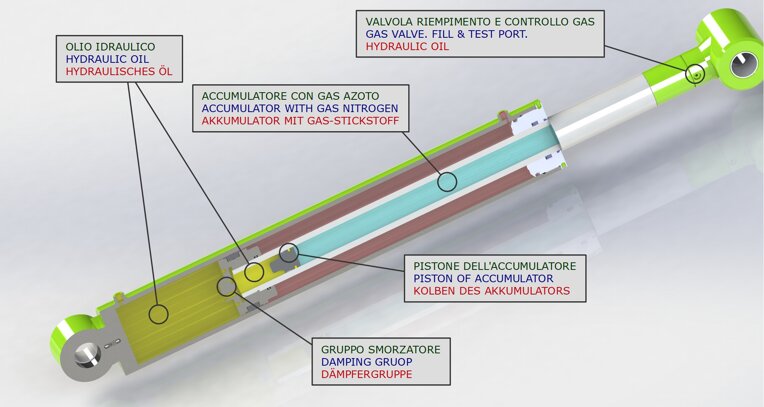
The Antonioni HS cylinder offers exceptional versatility, being able to be configured to operate with damping in both compression and tension, thus adapting to different application needs. The figure illustrates an example of a configuration with compression damping, where the system intervenes to absorb shocks and vibrations during the compression phase of the cylinder.
Operation in compression:
In the event of overload or impact, the oil present in the compression chamber of the cylinder is forced to flow through the damper unit, a key component of the Antonioni HS system. This controlled passage of oil occurs in the piston, where the exerted pressure compresses the gas present in the accumulator integrated within the rod.
The compression of the gas in the accumulator plays a fundamental role in absorbing the kinetic energy generated by the impact, transforming it into potential energy. This progressive damping process significantly reduces the stresses transmitted to the structure, protecting the components from damage and extending their lifespan.
During the compression phase, the cylinder shortens, absorbing the shock. The damper unit, thanks to its engineered design, precisely controls the retraction speed of the cylinder, ensuring a smooth and controlled movement.
Versatile configuration:
The Antonioni HS system offers the possibility to configure damping in both compression and tension, simply by reversing the oil flow inside the cylinder. This flexibility allows the system to be adapted to a wide range of applications, optimizing performance based on the specific needs of each customer.
Our experience and expertise allow us to provide technical consultation and support in choosing the optimal configuration for your application. Contact us to find out how the Antonioni HS system can improve the performance and reliability of your hydraulic systems.
The damper
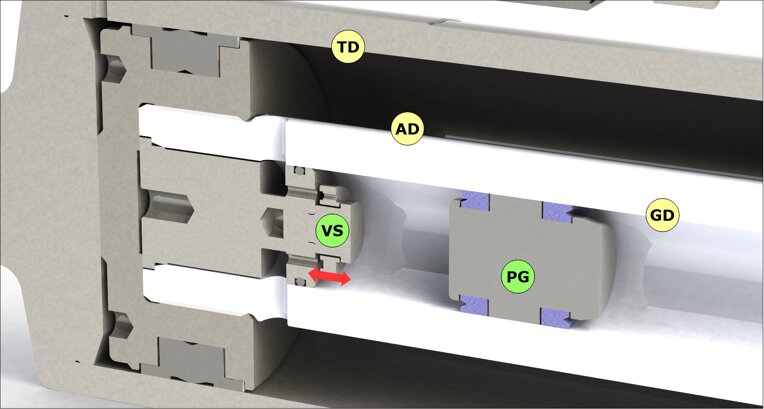
The core of the system are the components (PG) and (VS).
(PG), the accumulator piston must ensure excellent sliding properties and a perfect dynamic gas seal. For this reason, the surfaces on which it slides have a particularly high finish on which special seals operate.
(VS), the damping valve, allows for a high gas compression flow but a controlled-speed decompression through a calibrated orifice.
The benefits
- Safe operation with locking valves: The system is designed to operate efficiently even in combination with locking valves, ensuring the safety and stability of the system.
- Versatile configuration: The cylinder can be configured for damping in both tension and compression, offering unprecedented flexibility to adapt to different application needs.
- Simplified hydraulic circuit: The absence of an additional hydraulic circuit between the cylinder and the accumulator reduces the complexity of the system, improving reliability and facilitating installation.
- Superior dynamic performance: The system ensures high dynamic performance of oil transfer, ensuring effective and responsive damping even under heavy load conditions.
- Compact and safe design: The elimination of external expansion vessels reduces the cylinder's overall dimensions and protects the system from accidental breakage.
- Dimensional stability: The use of special steels and advanced production processes minimizes dimensional variations, ensuring the precision and reliability of the cylinder over time.
- Reliability in case of failure: A potential failure of the damping system does not compromise the main functionalities of the cylinder, ensuring operational continuity.
- Reduction of rebounds: The integrated damper effectively reduces rebounds, improving driving comfort and protecting mechanical components.
- Operator comfort: The reduction of vibrations and shocks improves operator comfort, reducing fatigue and increasing productivity.
- Lifespan of mechanical components: Effective damping reduces stress on mechanical parts, extending their service life and reducing maintenance costs.
- Availability of construction license: The system can be supplied under a construction license, allowing customers to integrate the Antonioni HS technology into their own products.
We are at your disposal to provide further information and technical support in choosing the most suitable solution for your needs.
The components
The quality and reliability of our hydraulic cylinders are guaranteed by a meticulous selection of components, chosen based on rigorous design specifications. We are able to meet the most stringent requirements of our customers, providing customized solutions and high-performance components, including:
- High-temperature seals: For applications in environments with extreme temperatures, ensuring sealing and durability over time.
- High-sliding seals: To reduce friction and optimize performance in applications with rapid and frequent movements.
- High-pressure seals: To ensure sealing and safety in high-pressure applications.
- Special steels: To ensure maximum strength and durability under heavy load conditions.
- Heat treatments: To improve the mechanical properties of the components and increase their wear resistance.
- Position sensors: For precise control of the cylinder's movement.
- Load/pressure sensors: To monitor in real-time the forces and pressures exerted on the cylinder.
- Laboratory tests: To ensure the conformity of products to the highest quality and safety standards.
Our attention to detail and the use of cutting-edge materials and technologies allow us to supply hydraulic cylinders of the highest quality, capable of meeting the most complex needs and ensuring optimal performance in every application.
Design
During the shock absorption phase, the gas inside the accumulator compresses, playing a crucial role in absorbing the overload and protecting the system.
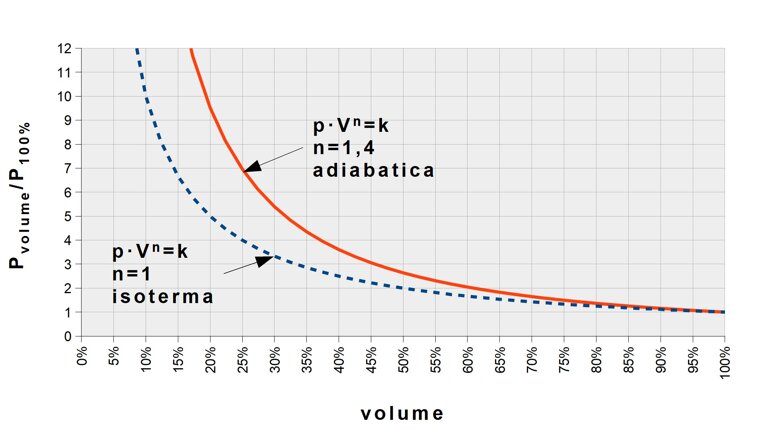
The attached graph illustrates the fundamental relationship between the pressure and the percentage of the accumulator's volume, with 100% corresponding to the initial calibration pressure. This graphical representation allows us to understand how the gas volume varies as a function of pressure, influencing the effectiveness of the damping.
To analyze the behavior of the system under different operating conditions, two distinct curves are considered:
- Adiabatic curve (continuous red line): This curve describes the behavior of the system in the presence of impulsive forces, that is, rapid and intense shocks. In these situations, the gas compresses rapidly, without exchanging heat with the surrounding environment.
- Isothermal curve (dashed blue line): This curve represents the behavior of the system during slow transitions between two steady states. In this case, the gas has time to exchange heat with the environment, maintaining a constant temperature.
Practical example:
Let's consider an Antonioni HS cylinder calibrated to a working pressure of 40 bar. If this cylinder is subjected to an overload of 120 bar (adiabatic transformation), equal to three times the initial load (P/P100% = 3), the corresponding volume of the accumulator will reduce to 45% of the initial volume.
In this scenario, the force absorbed by the cylinder, which is directly proportional to the pressure, will be three times greater than the initial force.
Temperatura
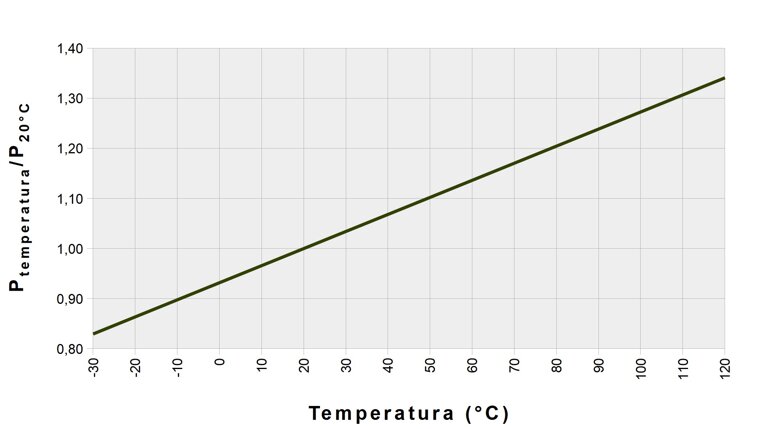
The thrust force of the gas inside the accumulator, determined by the charging pressure, is influenced by temperature variations.
Generally speaking, a temperature increase of about 10°C leads to an increase in the charging pressure of about 3.5%. Conversely, a decrease in temperature causes a reduction in pressure.
Practical example:
Let's consider an Antonioni HS cylinder charged to 50 bar at a temperature of 20°C. If the working temperature of the cylinder were to rise to 80°C, there would be an increase in the charging pressure of about 20%, bringing it to 60 bar.